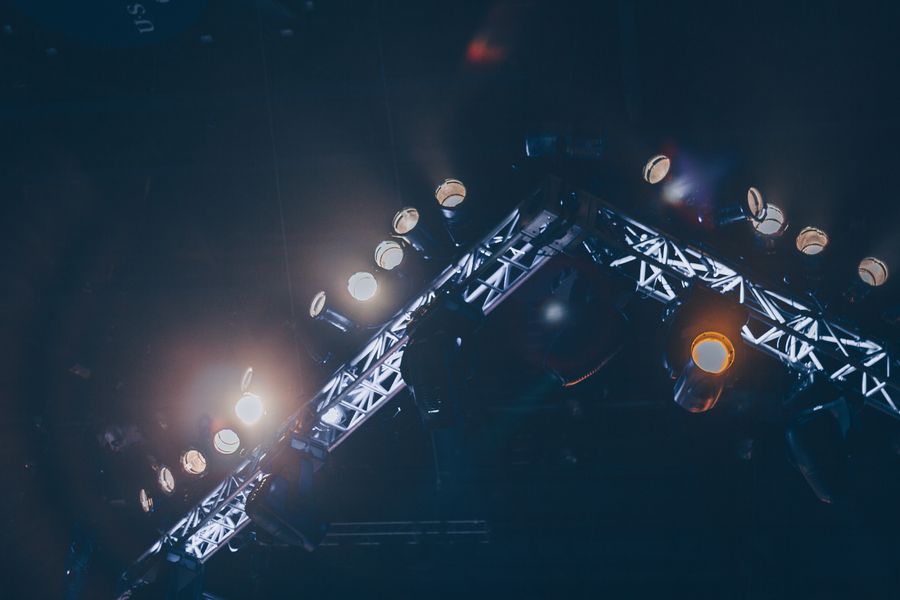
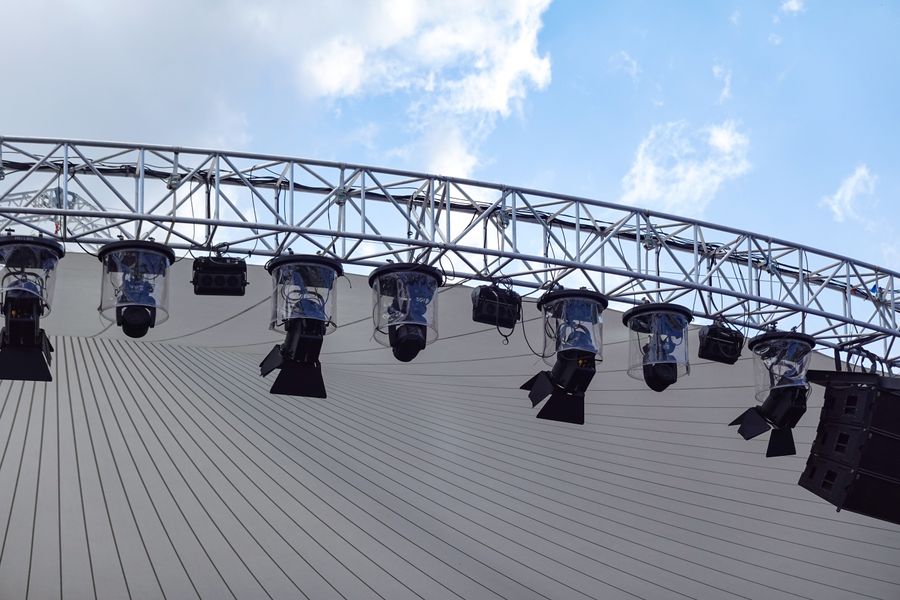
Lyon, 3e
Four thousand square metres over two floors: optics below, metal and assembly above, and a photometric bench in a blacked-out room at the back.
Nine people. Borosilicate blanks arrive as pressed discs, are ground to the step profile on a set of dedicated tools, then polished in three stages. The last stage is by hand, because the final pass on a step riser is where the difference between an acceptable lens and a good one lives.
Yield runs around 88%. Rejected lenses are broken up and returned to the glassworks rather than sold as seconds — a lens with a visible ring artefact would end up in somebody's rig eventually.
Housings are folded from sheet aluminium on site, welded, and wet-sprayed rather than powder-coated. Wet paint is more work and touches up invisibly ten years later, which matters for fixtures that spend their lives being knocked against truss.
Fixtures are built at benches, one person to a fixture, start to finish, with their initials on the build card inside the housing. Not for sentiment — when a fault pattern appears, we can trace it to a batch, a bench and a week.
Every unit runs for four hours at full output before packing, and the last ten minutes are on a dimmer sweep from 100% down to 0.1% while somebody watches for flicker and for the step that cheap drivers show around 3%.
A 12 m blacked-out room with a rail-mounted illuminance meter. Every new design is measured here across its full zoom range, and the published beam angles and centre intensities come from these measurements rather than from a supplier's LED data sheet.
The distinction matters. A source rated at 300 W does not produce 300 W of usable beam; the difference between the array and the field is the optical train, and that is the number a lighting designer actually needs.
Two benches are permanently given over to repair, and they are busy. The oldest fixture through in 2025 was a 1989 tungsten fresnel that needed a new lamp base and a yoke bolt. We had both.
Parts availability is guaranteed twenty years from the last shipment of a model. Where a part genuinely cannot be remade — an obsolete driver, usually — we say so and offer a retrofit at cost rather than an upsell to a new fixture.
We show the works to specifiers, distributors and lighting students by arrangement, most weeks. It is a factory: closed shoes, hearing protection near the folder, and the lens workshop is warm.